Somebody once insisted I quote a fixed price for a project they described in two sentences. I gave them a number three times what they expected, and they felt insulted. They shouldn’t have been. The number wasn’t a reflection of the work. It was a reflection of everything I didn’t know about the work, priced as risk, because a fixed price on a vague scope is nothing more than a gamble, and I’d rather price that risk than pretend it’s not there.
Most arguments about pricing models are framed as a question of trust, or of who’s trying to rip the other off. That framing is wrong, and it costs both sides money. This isn’t a moral question, it’s about where the risk of the unknown sits, and who’s better placed to carry it. Get that wrong and you’ll either overpay for certainty you didn’t need, or buy a fixed price that turns into a fight later.
This is the conversation I have when a client asks me “so how do you charge?” and expects a one word answer.
A pricing model is a way of deciding who pays when reality disagrees with the plan.
The two models, plainly
Fixed price. You agree on a scope and a number up front. The number doesn’t move. If the work takes twice as long as I estimated, that’s my problem, and I eat the difference. If it takes half as long, that’s my upside, and I keep it. You get a predictable bill. I get predictable revenue only if I estimated well.
Time and materials (T&M). You pay for the hours actually worked, usually at an agreed rate, billed as we go. If the work takes longer, the bill is bigger. If it takes less, you pay less. You carry the uncertainty. I carry almost none of it, because I’m paid for effort regardless of how much effort the thing turns out to need.
That’s the whole mechanism. Everything else is a way of splitting the risk more finely.
Neither model is honest or dishonest on its own. A fixed price can be a fair deal or a trap. T&M can protect you or quietly bleed you. Which one it is depends almost entirely on how well defined the work is before anyone signs.
What each model actually optimizes for
Fixed price optimizes for certainty of price. You know the number before you commit. That’s genuinely valuable when you’re the one who has to defend the number to a board, a co-founder, or a bank. It converts an open ended engineering effort into something you can plan around.
But that certainty isn’t free, and it isn’t magic. When I quote a fixed price, I’m carrying the risk that I estimated wrong, and I price that risk in. On a sharply defined scope that is small, because there’s little I don’t know. On a vague scope it’s large, because I have to protect myself against every direction the project could wander.
T&M optimizes for flexibility and speed. Nobody has to write a specification precise enough to hold up as a contract before work starts. We can begin Monday, learn as we go and adjust course whenever there’s the need. For work where the requirements genuinely aren’t known up front, that isn’t just cheaper, it’s usually the only model that holds up on its own.
The trade is that flexibility and open ended cost are the same thing seen from two sides. The freedom to change direction is also the freedom for the bill to keep growing.
Who carries the risk
Under fixed price, the vendor carries the risk of the work being bigger than expected. But read that sentence carefully, because it has a dark side. When the vendor carries the risk and reality goes against them, they have exactly two levers: cut corners, or fight you on scope. A fixed price vendor who’s underwater on your project now has a conflict of interest with you. Their incentive is to do the minimum that satisfies the letter of the agreement and to classify everything else as “out of scope, that’s a change request.” The model that was supposed to protect you now has your vendor optimizing against you.
Under T&M, the client carries the risk of the work being bigger than expected. The upside is that the vendor has no reason to cut corners or fight about scope, because they’re paid either way. Their incentive is aligned with quality and honesty about what things take. The downside is equally structural: they also have no financial reason to be fast. Every inefficiency, every needlessly elaborate piece of engineering, every hour spent on something that didn’t need doing, you pay for all of it, and nothing in the model pushes back.
You can’t buy a pricing model with no bad incentive, but you can choose the one you’re better placed to manage.
When fixed price is a trap
A fixed price on a vague scope is a trap for both sides. Here’s the mechanism. To quote a fixed number, I have to imagine the entire project and price it. If the scope is loose, I imagine one version of it. You, meanwhile, imagine a different version, usually a bigger one, because in your head the vague description obviously includes the things you forgot to write down. We sign. Then reality arrives, and it matches neither of our imaginations.
Now every status update becomes a negotiation. You think the feature was implied. I think it was extra. We think we are both right, but the contract just wasn’t precise enough, so we’re litigating it in the middle of the project. This is how fixed price projects die, in a hundred small arguments about whether a given thing was “in scope,” each one eroding the relationship a little more.
And it self selects for the wrong vendors. Ask two agencies for a fixed price on a loose spec. The careful one prices in the uncertainty and looks expensive. The one who lowballs either doesn’t understand the risk or plans to make it back on “changes” once you’re locked in. On a vague scope, the cheapest fixed quote is the most dangerous one, because there’s a gap hidden somewhere you’ll find in the worst possible moment.
When fixed price is a protection
Flip the condition and fixed price becomes one of the best deals you can get.
A fixed price on a sharp scope is real protection. When the work is genuinely well defined (a clear specification, a design that already exists, an integration with a documented system, a data migration whose shape is already clear) there’s little uncertainty left to price. And now the vendor carrying the risk works entirely in your favor: if they estimated badly, that’s their loss, not yours.
Can you write down what “done” means, unambiguously, before work starts? If you can hand someone a document and they can tell you, without a single clarifying question, exactly what the finished thing does, you should reach for a fixed price.
Honestly, I rarely see it happen. Most specs that feel complete to a non technical client still leave the technical choices unspoken, uncertainty in disguise, waiting to turn into cost. That isn’t a criticism. It’s just not your job to know which details carry the risk. It’s mine.
When T&M protects the client, and when it leaves them exposed
T&M gets a bad reputation because it looks like a money pit. Sometimes it is. But there’s a real condition under which it’s the model that protects you.
T&M protects you when the work is genuinely unknowable up front:
- Early stage product discovery, where you’re still learning what customers want.
- R&D, where the answer to “is this even possible?” is part of the work.
- A rescue job on a system nobody fully understands yet, where the first month is spent digging through the code just to understand how it works.
In all of these, a fixed price would be unsuitable, because neither side can define “done” honestly. Forcing a fixed number here doesn’t remove the uncertainty. It just transfers it to whoever’s worse at estimating. T&M lets you pay for the actual work and steer as you learn.
T&M leaves you exposed when the work could have been scoped but you skipped that anyway, or when nothing in the deal gives the vendor a reason to be efficient. An open ended T&M engagement with no cap, no milestones, no regular delivery of something you can actually look at, and a vendor you haven’t worked with before, is one of the easiest ways to overpay there is. Not because most vendors are dishonest, but because the model gives them no reason to be fast and gives you no early signal when they aren’t. The bill just grows, and by the time it looks alarming you’re already deep in.
Here’s how to tell the difference:
- Is there a time limit? Having none with a new vendor is a risky bet.
- Do you see real output on a short cadence? If you see nothing for two months and then a big invoice arrives, you have no way to check whether the hours matched the work.
- Was the work actually unknowable, or just undefined? Unknowable work belongs on T&M. Work that was simply not written down belongs in a specification first. Dodging that part is paying by the hour to postpone a decision you’ll have to make anyway.
- Is the rate the only thing you compared? A cheaper hourly rate on a vendor who takes three times as long is more expensive. Here, speed and judgment are what you’re actually buying.
The hybrids that actually work
Most engagements I run are hybrid, because almost every real project has a well defined part and an unknowable part living side by side. The art is putting each part on the model that fits it.
Fixed price discovery, then T&M (or fixed) build
You start with a small discovery phase whose deliverable is clarity: a specification, a technical plan, an estimate, a clear read on the parts most likely to cause trouble. The findings can’t be known in advance, but the phase itself is easy to bound and to put a price on.
Then you use that clarity to choose the model for the build. Sometimes discovery reveals the work is well defined enough to confidently price the whole solution in advance. Sometimes it reveals genuine unknowns that belong on T&M. Either way, you’ve spent a small, capped amount to make sense of the unknown before committing the big money.
Discovery is the cheapest risk reduction on this page. In fact, for most projects I don’t charge for that first pass at all. It only becomes a priced phase of its own when a project turns out to be genuinely large, and if it does, I’ll tell you so plainly before starting. It’s the one thing I push almost every client toward, because it often lowers what they end up spending with me overall.
Capped T&M
You bill by the hour, but with a ceiling written into the contract. Below the cap you get all the flexibility of T&M. At the cap, the risk flips to the vendor, like a fixed price. It’s a genuine middle ground. Your exposure is capped at a number you agreed to, and you keep the freedom to change direction should you need it.
One real caveat: an honest vendor tries to come in under that cap, while others let the work expand to fill it. The protection is real, but it depends on trust and on you actually seeing the work as it happens.
Milestone based
The project is broken into chunks, each with its own defined deliverable and its own price, paid on completion. It’s a way of turning one big, scary fixed price into a series of small, verifiable ones. You’re never more than one milestone deep in risk. If something goes wrong, you find out early and cheaply, and you can change course or change vendor without losing the whole budget. It suits work that’s definable but large, where cramming the whole thing into a single fixed price would pile up so much estimation risk that no number could be fair to both of you.
The decision rule
Everything above reduces to one question, and it’s not “which model is better.” It’s this:
How well can you define “done” before work starts?
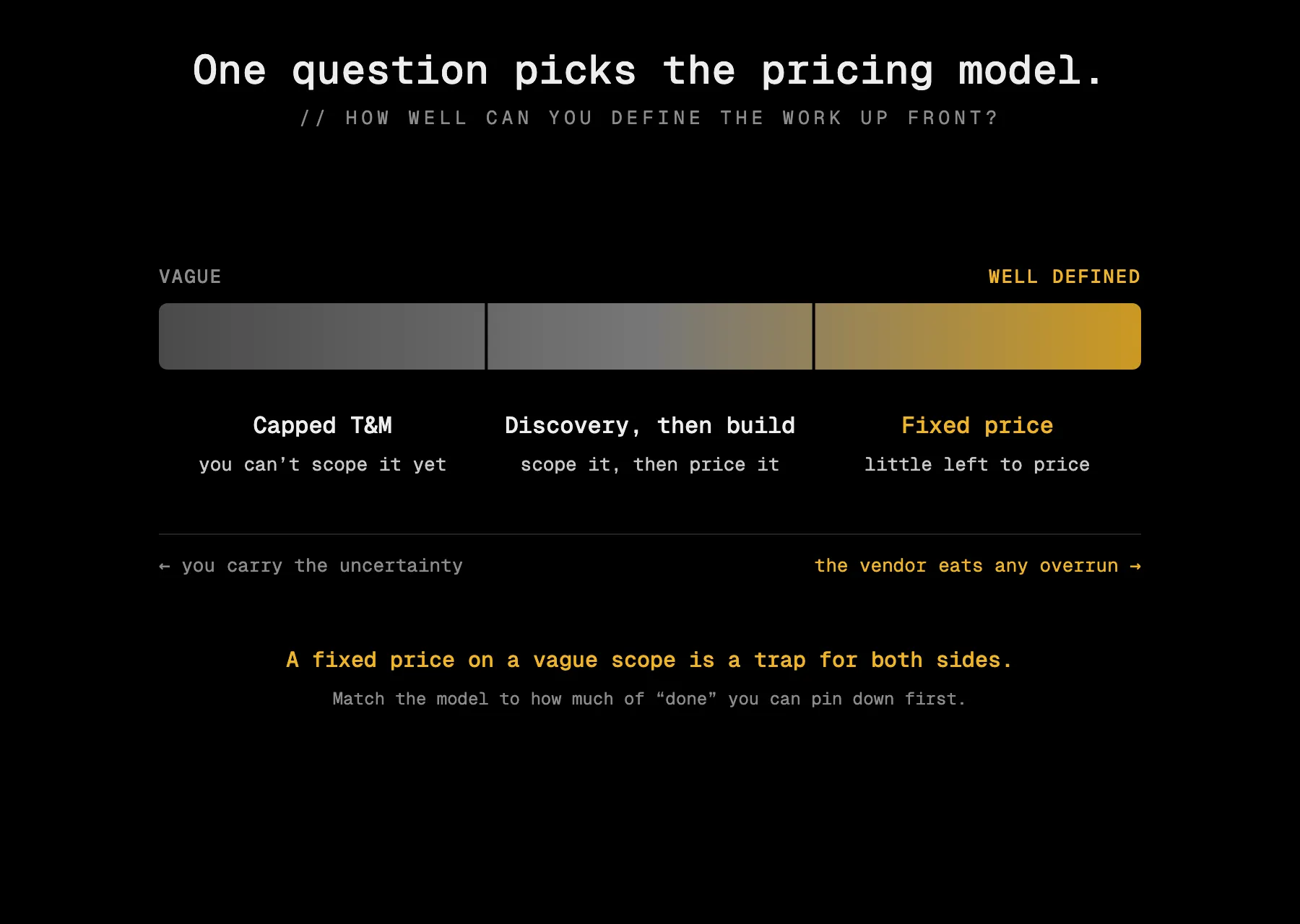
Then follow it down:
- You can define “done” precisely and unambiguously. Use a fixed price, or milestones if the project is large. You’ve earned the certainty and the premium is small. Take it.
- You genuinely can’t, because the work is real speculation. Use T&M, but protect yourself with a price cap and a short review cadence.
- You can’t yet, but you probably could after some focused work. This is most projects. Buy a small fixed price discovery phase, get to a real definition, then choose the next step from a position of knowledge.
Notice what the rule does not depend on: how much you trust the vendor, how the industry usually does it, or which model sounds cheaper in the meeting. Most businesses decide on those three instead, and pay for it later.
There’s also a way to tell whether you’re being sold to honestly:
- A vendor who insists on a fixed price for work that clearly can’t be defined is either going to cut corners or fight you later.
- A vendor who pushes uncapped, open ended T&M and resists any cap or milestone structure is asking you to carry all the risk while they carry none.
The takeaway
Fixed price and time and materials aren’t a test of the vendor’s honesty. They’re two tools, and which one fits depends on how well defined the work is. It isn’t black and white either, most real projects want a mix of both.
If you’re staring at a quote and not sure whether the pricing model is fair, or you want help working out how to break down your project cleanly, let’s get on a call and figure it out together.