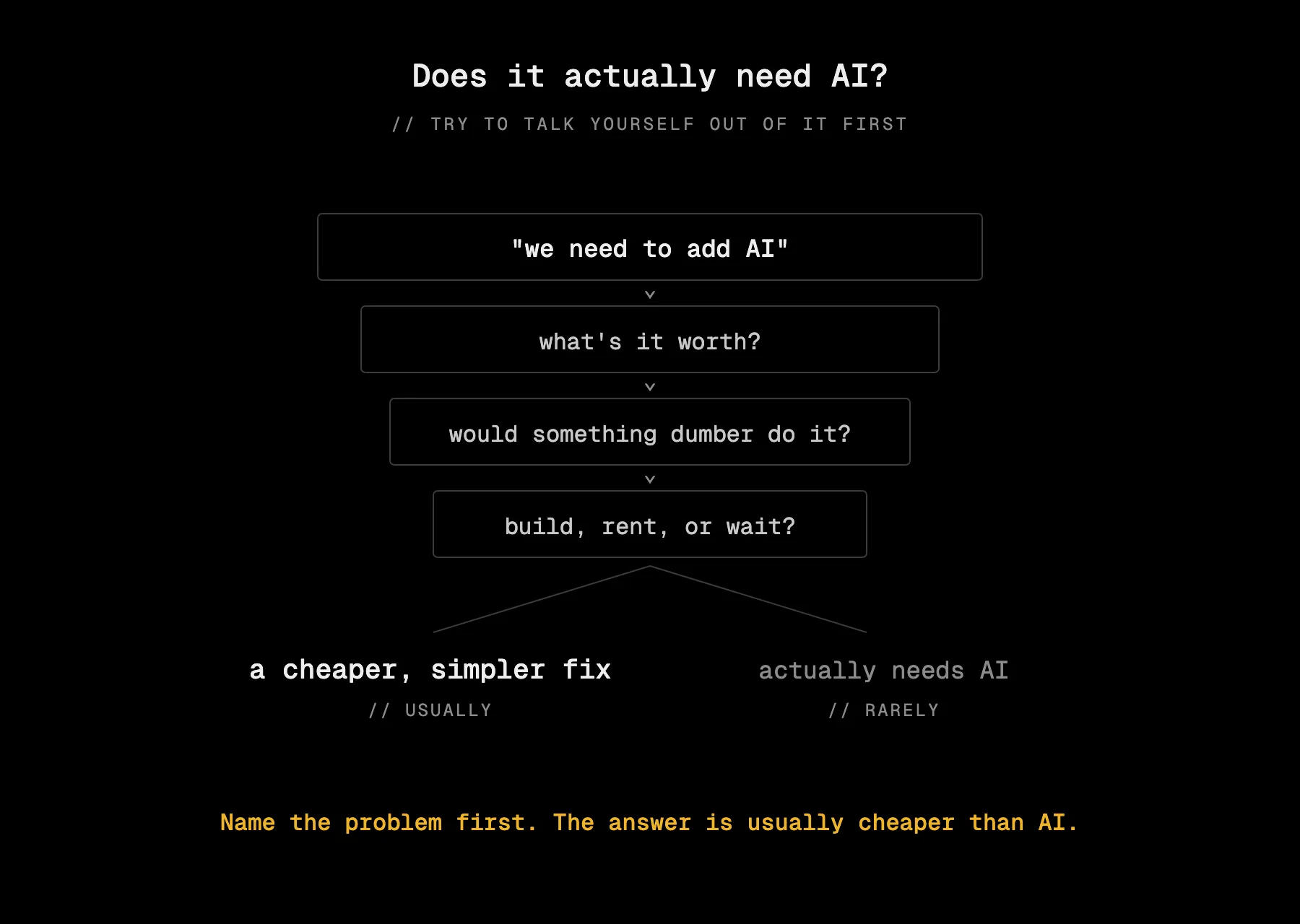
It has become pretty common now for me to hear “We need to add AI.” or some other version of the same thing. Sometimes it’s a founder back from a conference, sometimes a board that read the same three articles, sometimes a customer who asked. The urgency is real and the deadline is often yesterday.
So I ask the obvious thing back. “Add it to do what?”
And more often than not, they don’t know yet. “Add AI” arrived as the goal, when it was only ever a tool for reaching one.
“Add AI” is an answer looking for a question.
That doesn’t make it a bad idea in itself. Sometimes it’s exactly what you need. But you can’t tell yet, and neither can I, until we’ve actually named the problem we’re solving. This post is exactly that: how to tell whether you need AI at all, and what to do about it if you do.
Start from the problem, not the tool
You don’t walk into a hardware store and buy the most expensive power tool on the shelf before you know whether the job is a dripping tap or a whole new kitchen. You look at the job first, then pick the smallest tool that does it well.
AI is a tool. A genuinely remarkable one for a few specific jobs, and an expensive, unpredictable overkill for most of the others. So the first move is always the same: name the problem in plain words, in terms of money or time or risk.
Once that’s done, the cheapest fix often has nothing to do with AI at all:
- You wanted AI “so people can just ask where things are.” Nine times out of ten, what you actually needed was a search box that works properly, one that goes through the right fields and tolerates a typo. That’s a solved problem, it’s cheap, and it gives the same answer every single time.
- You wanted AI “to flag the risky orders.” If you can tell me the rule, “flag anything over 500 euros from an account less than a week old,” then that’s a simple rule, easy to turn into code. It costs almost nothing, it’s instant, and crucially it’s never wrong in a way you can’t explain. A surprising amount of real fraud detection is built from stacked rules exactly like this, long before anything fancier gets involved.
Most “we need AI” problems have a simpler, well understood solution hiding underneath. It’s cheaper, it’s predictable, and it never makes things up. Rule that out first.
The questions to ask instead
1. What is this problem worth? In real numbers. Hours a week, euros a month, deals lost, customers annoyed. If you can’t put a rough figure on the problem, you have no way to judge whether any solution, AI or not, is worth its cost.
2. Would something dumber solve it? Try to talk yourself out of AI first. If a boring, predictable, cheaper tool does 90% of the job, the remaining 10% almost never justifies the jump to something that costs more and behaves less predictably.
3. Build, rent, or wait? If you genuinely do need AI, you have three options, and for most businesses your size they’re very lopsided.
- Wait. The software you already pay for has a room full of engineers who had your exact idea months ago. There’s a good chance the feature you’re about to commission ships next quarter as part of the subscription you already have.
- Rent. This is usually the answer when you can’t wait. You don’t build the intelligence yourself, you rent it from one of the big AI providers and your app calls it over the internet when it needs an answer. You pay per use, own none of it, and someone else keeps it running.
- Build your own. This is building an entire car factory because you want a car nobody else has. For an actual AI company, ok. For anyone else it’s a wildly expensive, faintly manic thing to take on. I only mention it so you can get the idea out of your head and move on.
4. What happens when it’s wrong? Normal software, when it breaks, breaks loudly and the same way every time, as the predictable result of a specific cause. AI is the opposite: ask it the same question twice and you can get two different answers. That brings three risks worth knowing:
- It makes things up. Something like ChatGPT is built to always produce a confident, plausible answer. It will essentially never tell you “I don’t know.” Picture an intern who would rather invent a fact than admit uncertainty, who also happens to be a very convincing writer.
- Your data leaves the building. Every question your app sends to an outside AI provider is your data, and often your customers’ data, going to a third party who may not even be in the EU. Did your customers agree to that? The AI Act and GDPR both care a great deal about the answer, and “we didn’t really think about it” is not a defense that ends well.
- You’re the one who’s liable. If the AI tells a customer they’re owed a refund they aren’t, that lands on you. If it hands someone the wrong medicine dosage, that’s the kind of mistake that gets settled in a courtroom.
None of this is a reason to avoid AI. It’s a reason to know what a wrong answer costs you before you ship, so you can decide whether that’s a risk you can live with.
When AI genuinely is the right call
So far I’ve mostly talked you out of it, so let me be just as clear about the flip side. There are jobs where AI is the right tool by a mile, and refusing to use it would be its own kind of stubbornness.
The input is genuinely messy. Free text, photos, scanned documents, the recording of a phone call. Things a human has to actually read and interpret, that no rule or filter could ever untangle. This is the real home turf. And you don’t always need a large language model (the ChatGPT style AI the hype is about) for messy input, but sometimes it is the reasonable choice.
High volume, cheap mistakes. Lots of repetitive work where being occasionally wrong costs almost nothing. Drafting a first version of a reply that a human then edits, suggesting tags, sorting a queue so the important things float up. The mistakes get caught and corrected as part of the process, and the time saved across thousands of small tasks is real.
It’s your actual edge. If the AI part is the product, the reason customers come to you rather than someone else, then it isn’t a bolt-on feature, it’s the whole point. That’s worth investing in properly, but you should already know that.
Sometimes the reason is just the hype
Investors expect to see AI, the market rewards it, or a big customer wants to hear the word out loud. That’s a genuine business reason, even if the product doesn’t benefit from it.
If that’s the goal, just say so. I’ll build it, it’s your money and your call. But I’ll also be straight with you: it will be expensive, we can make it look convincing fairly fast if appearances are the point, and you should assume the shine wears off. Just don’t assume it’s going to solve an actual problem, and don’t commission it like it has to last a decade when you only need it for a demo.
The exception: using it on yourself
Everything so far is about putting AI in front of your customers, inside your product. Point it at your own internal work instead and a lot of the caution flips. Used well, it genuinely does boost productivity, and the stakes are generally lower.
For instance, AI helps me write these posts. Not because I can’t write them, but because my hours are often worth more on client work than doing this. I like sharing what I know, so this is the compromise that makes it happen. A post used to take me around fifteen hours. Now it’s closer to two. The ideas and the opinions are already in my head, that part doesn’t change. The tool just gets me from a blank page to a rough draft in minutes instead of an afternoon. And it isn’t magic, those two hours are real work: correcting the tone, checking it still says what I meant, fact checking the parts it stated confidently and got wrong, and cutting the lines that read like a machine wrote them, or that it wrote three times over.
That’s the shape of good internal use: it speeds up the middle of work you already understand and would check anyway. My post for engineers goes deeper into where it helps and where it hurts.
The bill doesn’t stop when it ships
An AI feature is not something you build once and forget, and that catches people out. It arrives with two ongoing costs:
- When you rent the intelligence, every answer it gives costs a little, so unlike an ordinary feature you build once and run for almost nothing, the bill keeps climbing with use. It’s a running cost that feels trivial during testing but turns into a serious monthly bill once real customers are using it.
- The provider swaps in a new version of the model underneath you, and answers that looked spot on at launch begin to drift months later, without anyone changing a thing on your end. It will need looking after like any other part of your software.
The takeaway
You can’t “just add AI.” Name the problem underneath in plain words, and the right amount of AI, sometimes a lot, often none, tends to become obvious on its own.
The businesses that get real value out of AI aren’t the ones that added it the fastest. They’re the ones who worked out what they were fixing first, and weren’t too proud to hear that the fix was something far simpler and cheaper than they’d expected.
If someone’s told you that you need to “add AI,” and you’d like a straight answer about whether you actually do, that’s one of my favorite conversations to have, precisely because the answer is so often cheaper than expected.